








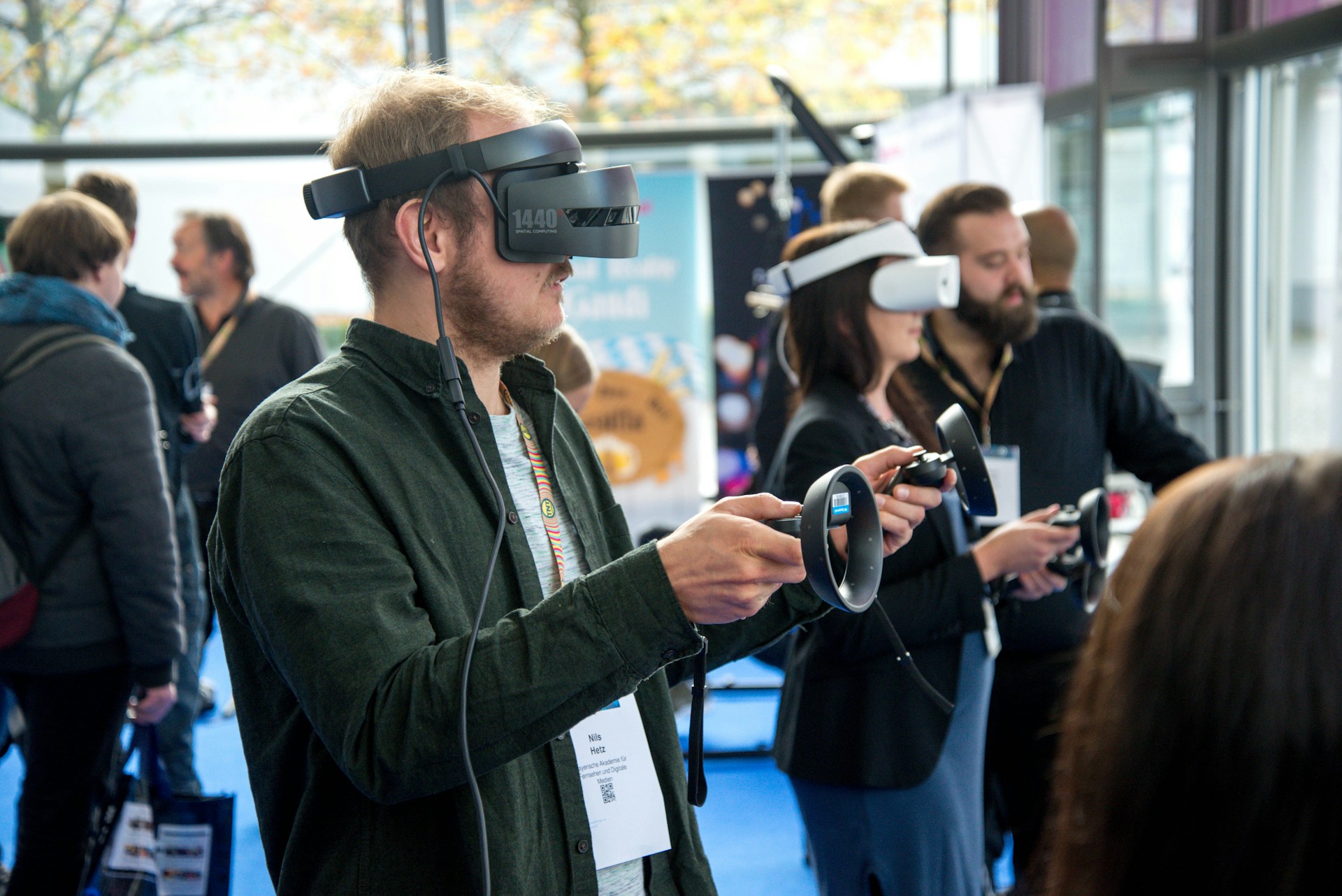
Virtual Reality (VR) has moved far beyond gaming. In 2026, VR innovation is entering a new era, driven by artificial intelligence, spatial computing, mixed reality, advanced sensors, cloud computing, and increasingly intelligent virtual environments.
The biggest change is simple: VR is no longer just about entering a virtual world — it is becoming a new way to interact with digital information, people, businesses, and machines.
The Rise of Intelligent Virtual Reality
Traditional VR created pre-designed digital environments. In 2026, AI-powered VR is making these environments more dynamic and interactive.
Generative AI can help create virtual characters, environments, conversations, training scenarios, and personalized experiences. Instead of interacting with predictable computer-controlled characters, users can increasingly communicate with AI-powered virtual assistants that understand natural language and respond in real time.
This convergence of Generative AI and Virtual Reality could become one of the most important technology trends of the decade.
Spatial Computing Is Redefining VR
One of the biggest innovations surrounding VR in 2026 is spatial computing.
Spatial computing allows computers to understand physical spaces, objects, movement, and the user’s position. Advanced cameras, depth sensors, LiDAR, eye tracking, hand tracking, and computer vision allow digital content to interact more naturally with the physical world.
This is creating a powerful combination of:
- Virtual Reality (VR)
- Augmented Reality (AR)
- Mixed Reality (MR)
- Artificial Intelligence (AI)
- Spatial Computing
Instead of thinking about VR as a headset displaying a virtual screen, the industry is increasingly moving toward computing environments that understand the user’s surroundings.
VR Gaming Is Becoming More Immersive
Gaming remains one of the biggest drivers of VR innovation.
Modern VR headsets are offering higher-resolution displays, better tracking, improved graphics, wireless connectivity, and increasingly sophisticated controllers. The 2026 VR market also includes standalone headsets, premium spatial-computing devices, PC VR systems, and console-based VR platforms.
But the next generation of VR gaming is not simply about better graphics.
AI can create dynamic environments, intelligent NPCs, personalized missions, and worlds that change based on player behavior.
Imagine entering a game where the environment is generated around your decisions and where every character can have a unique AI-driven personality.
That is the direction VR gaming is heading.
Virtual Reality Is Transforming Business
Businesses are also discovering that VR can be more than an entertainment platform.
Companies are increasingly exploring VR training, virtual collaboration, digital twins, remote assistance, product visualization, and immersive customer experiences.
For example, a manufacturing company can create a virtual replica of a factory and train employees before they enter the real facility.
A global company can create a virtual meeting environment where employees interact with 3D models instead of traditional video calls.
Architects can allow customers to walk through a building before construction begins.
Retail companies can create immersive shopping experiences where customers interact with products virtually.
This makes enterprise VR one of the most promising applications of immersive technology.
Healthcare Could Be One of VR’s Biggest Opportunities
The healthcare industry is another major area of VR innovation.
VR is being explored for medical education, surgical simulation, rehabilitation, mental-health applications, pain management, and professional training.
In 2026, researchers are also combining VR with AI-powered assistants to create interactive training environments. For example, recent research has demonstrated an AI-driven VR training platform for complex medical procedures, combining immersive simulation with knowledge-aware AI assistance.
This could eventually allow medical students and professionals to practice complicated procedures in highly realistic virtual environments without putting patients at risk.
Education Is Becoming Immersive
Imagine learning about ancient Rome by walking through a reconstructed Roman city.
Instead of reading about the human heart, students could explore a three-dimensional beating heart.
Instead of watching a chemistry experiment, students could perform it inside a virtual laboratory.
This is the promise of VR education.
Immersive learning can turn abstract concepts into experiences. Combined with AI tutors, virtual classrooms could become personalized learning environments where students ask questions, explore concepts, and receive immediate assistance.
The Future of Digital Twins
Another major VR innovation is the growth of digital twins.
A digital twin is a virtual representation of a real-world object, building, machine, or environment.
With VR and spatial computing, engineers can interact with these digital representations in three dimensions.
A factory could have a virtual replica that allows engineers to inspect machinery remotely. Cities could develop digital versions of infrastructure for planning and simulation. Businesses could model production environments before making expensive physical changes.
This combination of digital twins + AI + VR + IoT could fundamentally change how organizations design, operate, and maintain physical infrastructure.
3D Content Creation Is Becoming Faster
Creating high-quality 3D environments has traditionally been expensive and time-consuming.
AI is changing that.
New technologies are making it easier to generate, reconstruct, edit, and interact with 3D environments. Research in 2026 is exploring technologies such as 3D Gaussian Splatting, which can support efficient rendering and interactive manipulation of complex virtual scenes.
This matters because the future of VR depends on having enormous amounts of high-quality digital content.
AI could dramatically reduce the time and cost required to create that content.
VR and the Future of Remote Work
Remote work could also evolve beyond traditional video conferencing.
Instead of looking at dozens of faces on a screen, employees could enter virtual offices, interact with 3D objects, collaborate on virtual whiteboards, and participate in immersive presentations.
The long-term vision is not necessarily to recreate the office exactly.
It is to create digital workspaces that provide capabilities impossible in the physical office.
Imagine an engineering team located across five countries examining the same virtual machine, rotating it in three dimensions, highlighting components, and asking an AI assistant to explain potential problems.
That is where VR becomes more than communication technology.
It becomes a collaboration platform.
The Biggest Challenge: Making VR Comfortable and Accessible
Despite enormous progress, VR still faces challenges.
Headset weight, battery life, motion sickness, cost, limited content, privacy concerns, and social acceptance remain important barriers.
The industry is therefore moving toward lighter devices and broader XR (Extended Reality) ecosystems rather than relying exclusively on traditional headsets. Current industry analysis suggests that the market is increasingly expanding toward lightweight smart glasses and mixed-reality devices alongside conventional VR hardware.
The future may not be a world where everyone wears a large VR headset all day.
Instead, we may see a combination of:
Smart glasses + VR headsets + AI assistants + spatial computing + cloud services.
What Comes Next?
The most exciting part of VR innovation in 2026 is that several technologies are converging simultaneously.
AI provides intelligence.
VR provides immersion.
Spatial computing provides environmental awareness.
Cloud computing provides scalability.
5G and advanced connectivity provide real-time communication.
Together, they are creating a new generation of digital experiences.
The next version of the metaverse may therefore look very different from the early vision of virtual shopping malls and digital avatars. The emerging direction is more practical: AI-powered immersive environments designed for work, education, healthcare, entertainment, engineering, training, and everyday interaction.
Final Thoughts
VR innovation in 2026 is not simply about better headsets. It is about creating a new computing paradigm.
The real breakthrough will happen when virtual environments become intelligent, responsive, personalized, and connected to the physical world.
As Artificial Intelligence, spatial computing, mixed reality, digital twins, and immersive technology continue to converge, VR could become one of the most important interfaces between humans and computers.
The virtual world is no longer just somewhere we visit.
It is becoming somewhere we work, learn, create, train, collaborate — and eventually, live parts of our digital lives.
For businesses and technology innovators, the message is clear:
The next digital revolution may not happen on a screen. It may happen all around us.